top of page


2026
Science
The global biogeography of passerine songs
Bacquelé, Q., Barnagaud, J.Y., Violle, C., Theunissen, F., Mathevon, N.
By analyzing the acoustic architecture of songs from more than 3000 passerine species worldwide, we show that the acoustic space of bird songs can be structured around eight elemental motifs. The differential use of these motifs is driven by a combination of species’ biological traits (social organization, morphology, and mating system) and the physics of sound propagation.

2025
Current Biology
Ultrasonic signals support a large-scale communication landscape in wild mice
Perrier, L., Lego, L., Cladière, T., Blanchard, M., Makuya, L., Berns, W., Pradeau, A., Schradin, C., Greenfield, M.D., Mathevon, N. & Levréro, F.
Wild African striped mice use short-range ultrasonic signals for large-scale communication. By vocalizing at key territorial locations, they extend the functional reach of these private signals, broadcasting group identity to differentiate between groupmates, neighbors, and strangers, mediating complex territorial dynamics.

2025
Science Advances
Versatile use of chimpanzee call combinations promotes meaning expansion
Girard-Buttoz, C., Neumann, C., Bortolato, T., Zaccarella, E., Friederici, A. D., Wittig, R. M., & Crockford, C.
Chimpanzee’s vocal communication shows a dual system with two meaning construction channels, such that when single calls are combined into bigrams they can either generate new meaning by creating non-compositional combinations or they can retain or modify their meaning, creating compositional combinations.

2025
Proceedings of the National Academy of Sciences
Puppy whines mediate maternal behavior in domestic dogs
Massenet, M., Philippe, R., Pisanski, K., Arnaud, V., Barluet de Beauchesne, L., Reynaud, K., Mathevon, N. & Reby, D.
Research using synthetic whines shows mother dogs recognize offspring and assess their condition via vocalizations. Mothers responded most to their litter's specific pitch, especially whines simulating weaker puppies. This proves vocal communication supports kin discrimination and condition assessment in mammals. These findings aid in developing vocal-based welfare monitoring tools to improve breeding practices and animal care.

2023
Proceedings of the Royal Society B
Crocodile perception of distress in hominid baby cries
Thévenet, J., Papet, L., Coureaud, G., Boyer, N., Levréro, F., Grimault, N., & Mathevon, N.
Crocodiles are sensitive to the degree of distress encoded in the vocalizations of phylogenetically very distant vertebrates. A comparison of these results with those obtained with human subjects confronted with the same stimuli indicates that crocodiles and humans use different acoustic criteria to assess the distress encoded in infant cries. The acoustic features driving crocodile reaction are likely to be more reliable markers of distress than those used by humans.
2023
Princeton University Press.
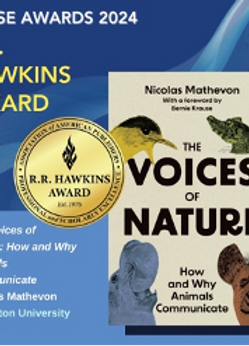
The Voices of Nature. How and Why Animals Communicate
Mathevon, N.
An epic journey into the world of bioacoustics. For amateurs and professionals alike. Excerpt from the book can be read here: https://tinyurl.com/3pehs4hj. This book won the prestigious top prize RR Hawkins Award together with the PROSE Award for Excellence in Biological and Life Sciences from the Association of American Publishers. It was also awarded Library Journal’s Best Science & Technology Book of the Year.

2020
Nature Communications
Evolution of communication signals and information during species radiation
Garcia, M., Theunissen, F., Sèbe, F., Clavel, J., Ravignani, A., Marin-Cudraz, T., Fuchs, J. & Mathevon, N.
We show that in woodpecker drumming the amount of species identity information encoded remained stable during woodpeckers’ radiation. Acoustic analyses and evolutionary reconstructions show interchange among six main drumming types despite strong phylogenetic contingencies. We only find character displacement in the rare cases where sympatric species are also closely related. Our results illustrate how historical contingencies and ecological interactions can promote conservatism in signals without impairing information transfer.
bottom of page